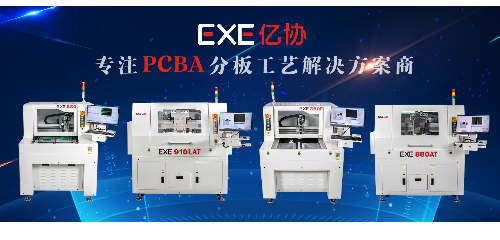
In the intricate world of electronics manufacturing, Printed Circuit Boards (PCBs) are the fundamental building blocks that enable the functionality of countless devices, from smartphones and laptops to complex industrial machinery. Once PCBs are fabricated in large panels for cost - efficiency and production convenience, the process of separating these panels into individual boards becomes crucial. This is where the PCB depaneling machine steps in, acting as the "precise cutter" that ensures clean, accurate, and damage - free separation, playing a pivotal role in maintaining the integrity and quality of the final electronic products.
I. Understanding PCB Depaneling Machines
A. Types of PCB Depaneling Machines
Manual Depaneling Machines
Manual depaneling machines are the most basic type. They typically consist of a simple cutting or separating mechanism that is operated by hand. One common example is the guillotine - style manual depaneling tool. In this setup, the PCB panel is placed on a platform, and a sharp blade, similar to that of a guillotine, is manually lowered to cut through the connecting tabs or break - away edges between the individual PCBs. Manual depaneling machines are cost - effective and suitable for small - scale production or prototyping, where the volume of PCBs to be separated is relatively low. However, they require a significant amount of operator skill and effort. The precision of the cut depends largely on the operator's dexterity, and there is a higher risk of introducing stress or damage to the PCBs, especially if the cut is not made evenly.
Semi - Automatic Depaneling Machines
Semi - automatic depaneling machines offer an upgrade over manual models. These machines usually incorporate some level of automation to assist the operator. For instance, a semi - automatic depaneling machine might have a motorized cutting head that can be controlled by the operator using buttons or a simple control panel. The machine can be programmed to make cuts at specific intervals or depths, reducing the physical strain on the operator and improving the consistency of the cuts. In a routing - based semi - automatic depaneling machine, the cutting head, equipped with a small router bit, follows a pre - set path on the PCB panel to separate the individual boards. The operator is still responsible for loading and unloading the PCB panels, but the cutting process is more precise and less labor - intensive compared to manual machines. This type of machine is suitable for medium - volume production, where a balance between cost and efficiency is required.
Fully Automatic Depaneling Machines
Fully automatic depaneling machines represent the pinnacle of PCB separation technology. These machines are highly sophisticated and are designed to operate with minimal human intervention. They are equipped with advanced sensors, high - precision motion control systems, and automated loading and unloading mechanisms. For example, a fully automatic depaneling machine may use optical sensors to detect the position and orientation of the PCB panel. Once the panel is loaded into the machine, the sensors communicate with the motion control system, which then guides the cutting or separating tool with micron - level accuracy. In a laser - based fully automatic depaneling machine, a high - energy laser beam is used to precisely cut through the PCB panel. The laser can be programmed to follow complex shapes, making it ideal for separating PCBs with irregular or intricate designs. These machines are capable of high - volume production, ensuring consistent quality and high - speed operation, and are widely used in large - scale electronics manufacturing facilities.
B. Key Components of PCB Depaneling Machines
Cutting or Separating Tools
The cutting or separating tools are the heart of a PCB depaneling machine. In mechanical cutting - based machines, such as guillotine - style or routing machines, the tools are designed to physically cut through the PCB material. Guillotine blades are usually made of high - carbon steel or tungsten carbide for durability and sharpness. They need to be able to cleanly slice through the fiberglass - epoxy substrate of the PCB without leaving rough edges or causing delamination. Routing bits, on the other hand, are small, high - speed rotating cutting tools. They come in various shapes and sizes, depending on the type of cut required. For example, a V - shaped routing bit is commonly used to make V - cuts along the separating lines of the PCB panel. In laser - based depaneling machines, the laser beam itself acts as the cutting tool. The laser source, which can be a CO₂ laser or a fiber laser, emits a highly focused beam of light that heats and vaporizes the PCB material, creating a clean cut.
Motion Control Systems
Motion control systems are essential for ensuring the precision of the depaneling process. In manual and semi - automatic machines, the motion control may be relatively simple, such as a hand - operated lever or a motor - driven linear slide. However, in fully automatic machines, advanced motion control systems are employed. These systems often use servo motors and precision ball screws or linear guides. Servo motors are capable of precise rotational control, which is translated into linear motion through the ball screws or linear guides. The motion control system can be programmed to move the cutting tool along a specific path, ensuring that the cuts are made exactly where they are needed on the PCB panel. In addition, the system can control the speed and acceleration of the cutting tool, optimizing the cutting process for different PCB materials and thicknesses.
Sensors and Detection Systems
Sensors and detection systems play a crucial role in the operation of PCB depaneling machines, especially in fully automatic models. Optical sensors are commonly used to detect the presence, position, and orientation of the PCB panel. These sensors can use visible light, infrared light, or laser beams to scan the panel. For example, a camera - based optical sensor can capture an image of the PCB panel and analyze it to determine the exact location of the separating lines. This information is then used by the motion control system to guide the cutting tool. In addition, sensors can also be used to detect the condition of the cutting tool. For instance, a force sensor can monitor the cutting force exerted by the tool. If the force exceeds a certain threshold, it may indicate that the cutting tool is dull or damaged, and the machine can be programmed to stop or alert the operator.