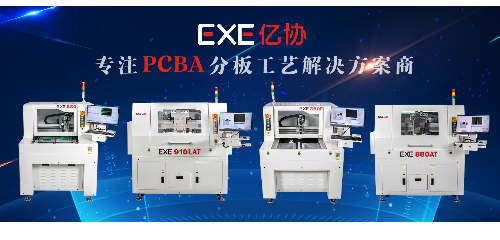
In PCB assembly, improper depaneling is one of the leading causes of hidden defects, component failure, and board scrap. Traditional methods like manual breaking, shearing, or V-cutting apply strong mechanical stress that can crack substrates, damage solder joints, or shift delicate components. A PCB router machine solves these problems by using a controlled, low-stress milling process. Below is how it effectively reduces stress and physical damage to PCB boards.
1. No Bending or Torsion Stress During Separation
Unlike manual snapping or jig-based cutting, PCB routing does not require bending, twisting, or pulling the panel.
The high-speed spindle mills along the connecting bridges gradually.
The board remains fixed and stable without flexing.
Eliminates internal stress that causes micro-cracks in the PCB substrate.
This is especially critical for thin PCBs, rigid-flex boards, and boards with fragile layers.
2. Protects Solder Joints from Mechanical Shock
Vibrations and sudden shocks during depaneling often weaken or crack solder connections, leading to early product failure.
PCB routers use smooth, continuous cutting with minimal vibration.
No impact force is transmitted to nearby SMD components.
Stable clamping prevents shaking during operation.
Solder joints remain intact, greatly improving long-term product reliability.
3. Prevents Damage to Delicate and High-Value Components
Boards with BGA, QFN, connectors, crystals, and sensitive chips are easily damaged by stress.
Routing allows controlled cutting paths away from critical parts.
No excessive force spreads across the board surface.
Reduces risks of component detachment, tombstoning, or internal damage.
This makes router machines ideal for automotive, medical, and industrial electronics.
4. Eliminates Edge Chipping and Board Deformation
V-cut and manual methods often cause ragged edges, chipping, or warpage.
Precision milling gives clean, straight cuts with minimal burrs.
The substrate structure remains stable without deformation.
Less post-processing or rework is required.
Smoother edges also reduce stress concentration in later assembly.
5. Controlled Cutting Force Reduces Internal Stress
PCB routers operate with optimized spindle speed and feed rate.
Cutting force is small, consistent, and predictable.
No excessive pressure is applied to any area of the board.
Residual stress inside the PCB is greatly reduced.
Lower internal stress means higher stability in temperature cycling and use.
6. Vision Positioning Prevents Misalignment and Scrap
Modern PCB routers feature CCD visual alignment systems.
Cutting paths are accurately positioned.
Avoids accidental milling of traces, pads, or components.
Greatly reduces damage caused by misalignment.
This adds an extra layer of protection for high-density circuit boards.
7. Suitable for Thin, Flexible, and Rigid-Flex PCBs
Thin and flexible boards are especially prone to breaking or wrinkling under stress.
Routing provides gentle, non-contact force separation.
Supports special fixtures for flexible material handling.
Avoids stretching, creasing, or tearing thin substrates.
Conclusion
The PCB router machine fundamentally reduces stress and damage by replacing high-force, high-impact separation with precision, low-stress milling. It protects the PCB substrate, solder joints, and sensitive components, minimizes micro-cracks and deformation, and significantly improves production yield and product lifetime. For high-value and high-precision PCB manufacturing, it is the most reliable depaneling solution available.